
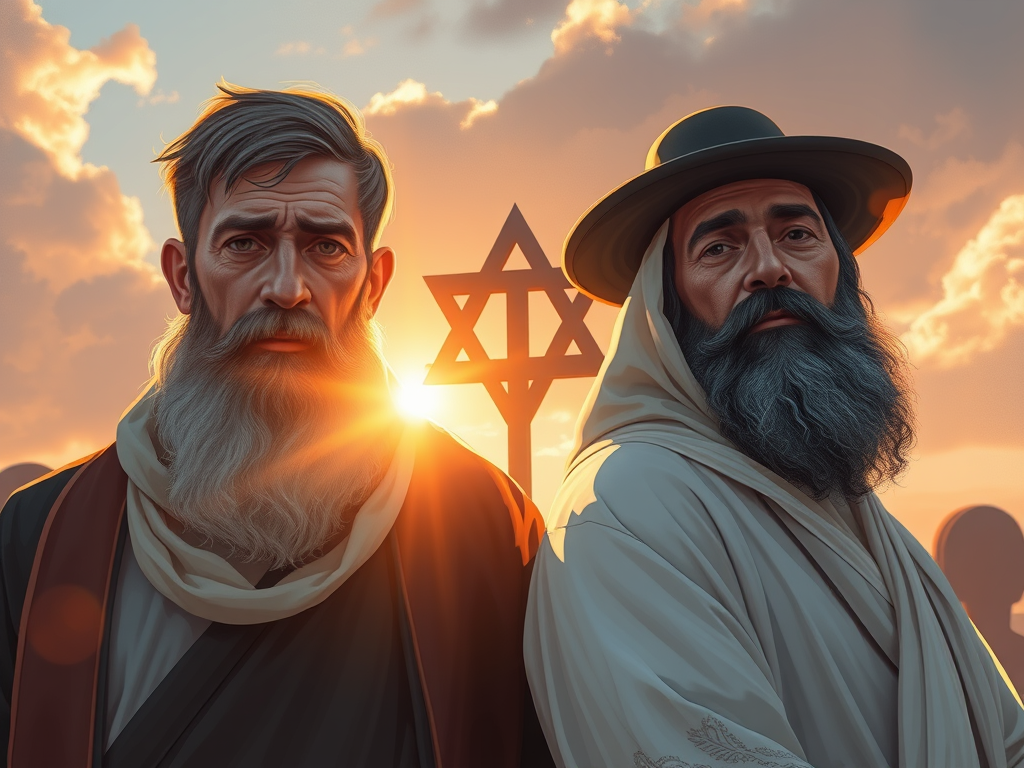
Equal Standing in Abraham’s Promise
Understanding God’s Choice, the Covenant Story, and the Identity of Abraham’s Descendants Today
Few biblical stories raise as many questions as the choice between Jacob and Esau. Why did God choose the younger brother? What was the purpose behind this reversal? And how does this ancient decision shape the identity of the Jewish people—and the identity of Gentile believers today?
This story is not about favoritism or arbitrary preference. It is about God’s redemptive purpose, the unfolding of the Abrahamic covenant, and the way God brings both Jews and Gentiles into His family.
Let’s explore the story in three movements:
- The covenant blessing Jacob received
- The divine reason for God’s choice
- The identity of Jacob and Esau’s descendants today
- How Gentile believers share in Abraham’s blessing—and how this relates to the Jewish people
1. The Covenant Blessing Jacob Received
Jacob was chosen to inherit the full weight of the Abrahamic covenant, the foundational promise God made to Abraham and reaffirmed to Isaac.
This covenant included:
A. A People
Jacob becomes the father of the twelve tribes of Israel, the covenant nation through whom God would work in the world.
B. A Land
The land of Canaan was promised to Abraham’s descendants. God personally reaffirms this promise to Jacob at Bethel.
C. A Mission of Blessing
Through Abraham’s line, “all nations of the earth will be blessed.” This blessing ultimately points to the Messiah.
D. God’s Presence
God promises Jacob, “I am with you… I will not leave you,” echoing the covenantal presence given to Abraham and Isaac.
In short:
Jacob was chosen to carry forward the covenant people, the covenant land, the covenant mission, and the covenant promise of the Messiah.
2. Why Did God Choose Jacob Instead of Esau?
The biblical narrative gives several clear reasons.
A. God declared His choice before the twins were born
Rebekah receives a divine oracle:
“The older will serve the younger.” — Genesis 25:23
This reversal of cultural norms shows that God’s choice was rooted in His own purpose, not human custom or merit.
B. The choice was not based on Jacob’s moral superiority
Jacob’s early life is full of deception and manipulation. Scripture never hides this.
But Esau, Scripture says, despised his birthright (Genesis 25:34). He treated lightly what God had declared sacred.
The point is not that Jacob was better. The point is that God’s choice was not based on human merit at all.
C. The choice served God’s redemptive plan
Jacob was chosen because the messianic line—the line leading to Jesus—would come through him.
This is the theological center of the story.
D. The choice reveals God’s freedom in directing the covenant story
Paul uses this story in Romans 9 to illustrate God’s freedom to shape the covenant narrative.
God chooses Jacob because the covenant must continue, and Jacob is the one through whom the promise will unfold.
3. Who Are Jacob and Esau’s Descendants Today?
Understanding their descendants helps modern readers see the story with clarity.
A. Jacob’s Descendants Today
Jacob’s name was changed to Israel, and his descendants became:
- The Israelites
- The Jewish people
Modern Jews trace their identity—historically, culturally, and often genetically—to Jacob and the twelve tribes of Israel.
So:
Jacob’s descendants today are the Jewish people and the broader historical nation of Israel.
B. Esau’s Descendants Today
Esau is also called Edom, and his descendants are known as the Edomites.
Historically:
- They lived in what is now southwestern Jordan, between the Dead Sea and the Gulf of Aqaba
- Later, some migrated into southern Israel/Negev, known as Idumea
Over time, through conquest and assimilation, the Edomites ceased to exist as a distinct people group.
So:
Esau’s descendants today are historically associated with the ancient Edomites of Jordan and the Negev.
4. Gentile Believers and Jewish Believers:
Do They Have Equal Standing Before God? Are They Joint Heirs?
Paul says in Galatians 3:
“If you belong to Christ, then you are Abraham’s seed, heirs according to the promise.”
This means:
- You are not ethnically Jewish
- You do not replace the Jewish people
- But you are fully included in the Abrahamic blessing through Christ
Let’s break this down.
A. Jewish People: Abraham’s Seed by Lineage and Covenant History
Jewish identity is rooted in:
- Biological descent from Abraham, Isaac, and Jacob
- National covenant (land, Torah, peoplehood)
- Historical role in salvation (Scripture, prophets, Messiah)
Paul says this covenant is irrevocable (Romans 11:29).
B. Gentile Believers: Abraham’s Seed by Faith in the Messiah
Gentile believers are not Abraham’s descendants by blood, but by union with Christ, the true Seed of Abraham.
Paul describes this as being grafted in to Israel’s covenant blessings (Romans 11).
You do not become Jewish. You do not replace Israel. But you become a full heir of the spiritual promises.
C. Equal Merit Before God
Yes. Absolutely. Without qualification.
Paul says:
“There is no Jew or Gentile… for you are all one in Christ Jesus.” — Galatians 3:28
This does not erase Jewish identity. It does not erase Gentile identity. It means equal standing before God.
Equal access. Equal grace. Equal adoption. Equal inheritance.
D. Joint Heirs According to the Promise
Paul uses this exact language:
“Heirs together with Israel.” — Ephesians 3:6
This is one of the most radical statements in the New Testament.
It means:
- Jewish believers and Gentile believers stand side by side
- Both receive the promises of Abraham
- Both are full members of God’s family
- Both share in the inheritance of Christ
Not two classes of believers. Not two tiers of covenant membership. One family in the Messiah.
Conclusion: One Story, One Messiah, One Family
The story of Jacob and Esau is not about favoritism. It is about purpose.
Jacob was chosen to carry the covenant line. Esau was not chosen for that role. Israel remains God’s chosen people in history. Gentile believers are God’s chosen people in Christ.
And in the Messiah, God brings both together:
- One olive tree
- One family
- One inheritance
- One hope
So, if you are a Gentile believer, you are truly Abraham’s seed—fully included, fully loved, fully heir to the promise.
Leave a Reply